Dareechah-e-Nigaarish
Dareechah-e-Nigaarish
Toronto, ON
Canada
talat

Zahid Dar: Biography
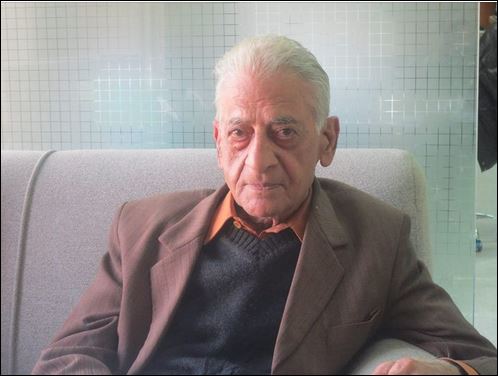
Zahid Dar (1936-2021) was a modern Urdu poet who preferred to write Free Verse and Prose Poems. During his lifetime, he published two collections of his poems from Lahore, Pakistan. These collections were, in chronolgical order, Mohabbat aur Maayoosee kee Nazmein and Tanhaaee. Much of his poems remain unpublished and in possession of his family after his death in 2021.
زاہد ڈار جدیدیت کا شاعر تھا ۔ ۔ ۔ زاہد ڈار سائنس اور قدیم روُحانی عُلوم کے امتزاج کا شاعر تھا ۔ ۔ ۔ وُہ ایک جدید فلسفی شاعر تھا ۔ ۔ ۔
My long Urdu poem about Modern Urdu Poet Zahid Dar . . . on my WordPress blog Naee Manzil . . . Click here to read it
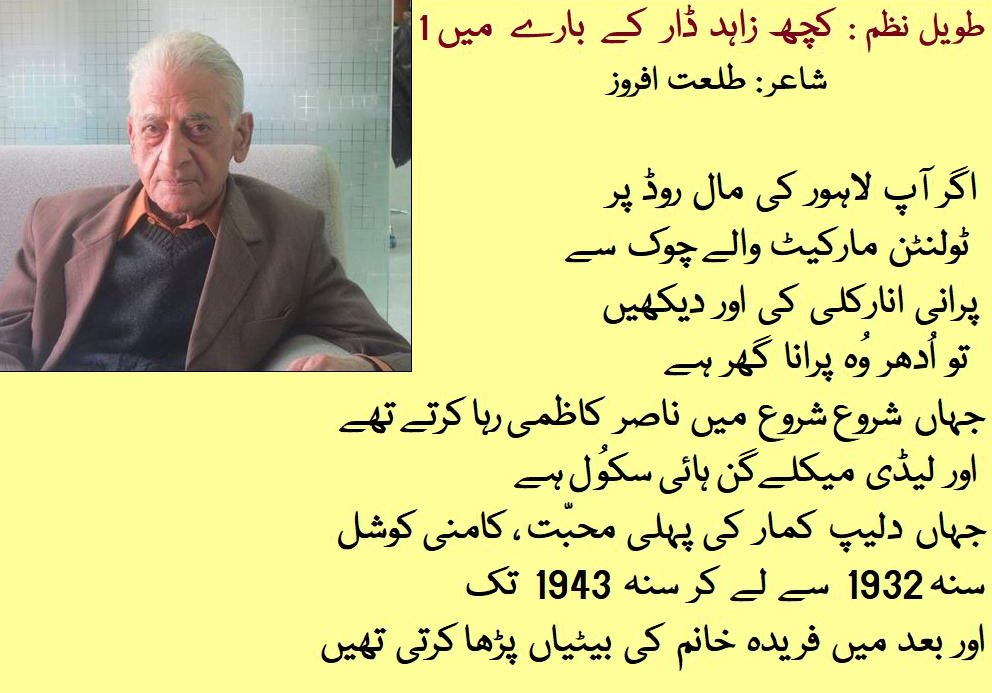
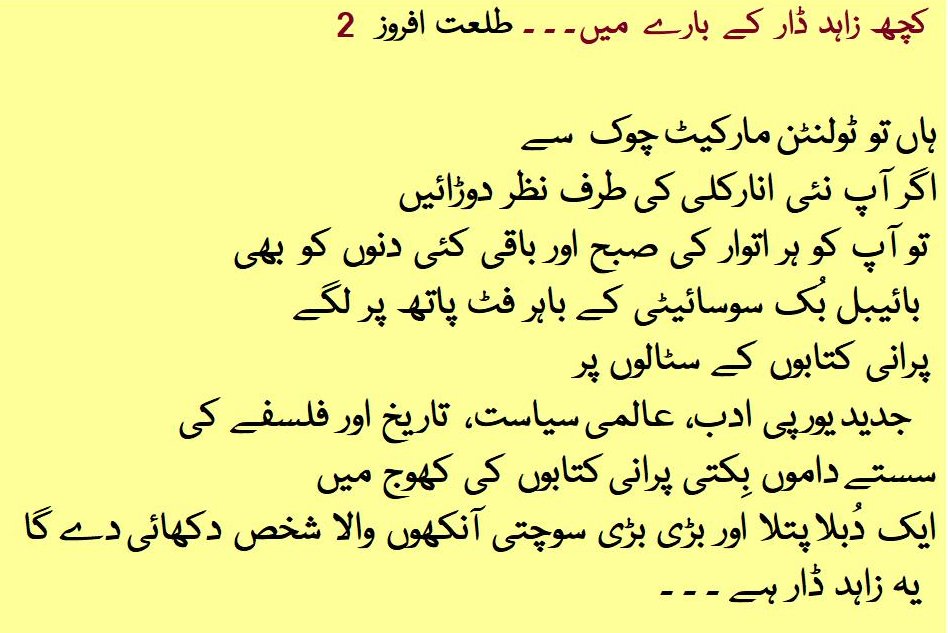
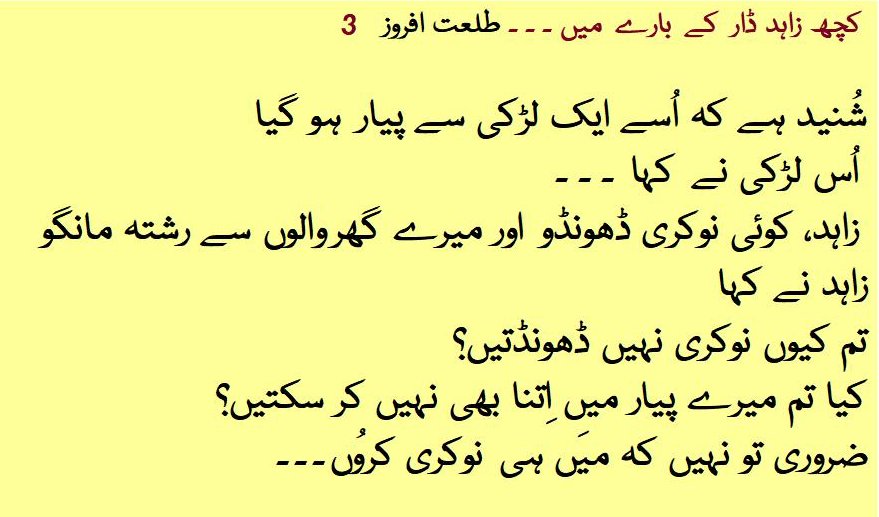



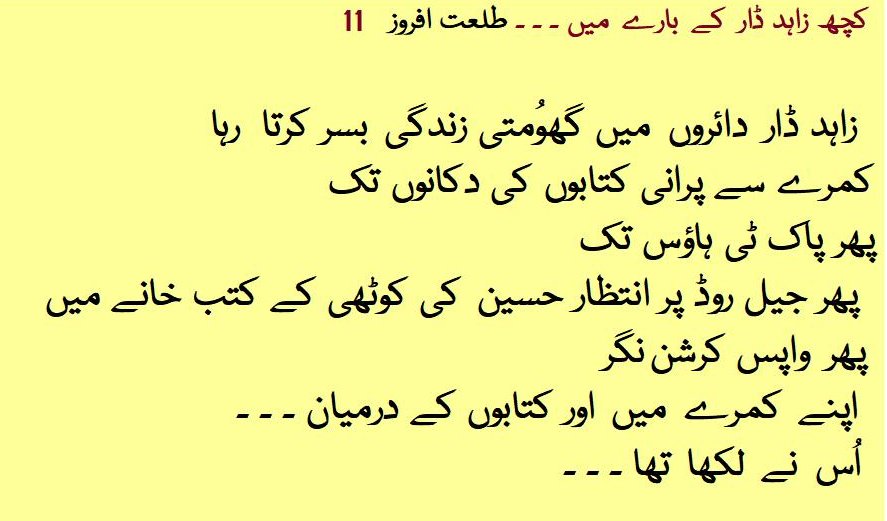
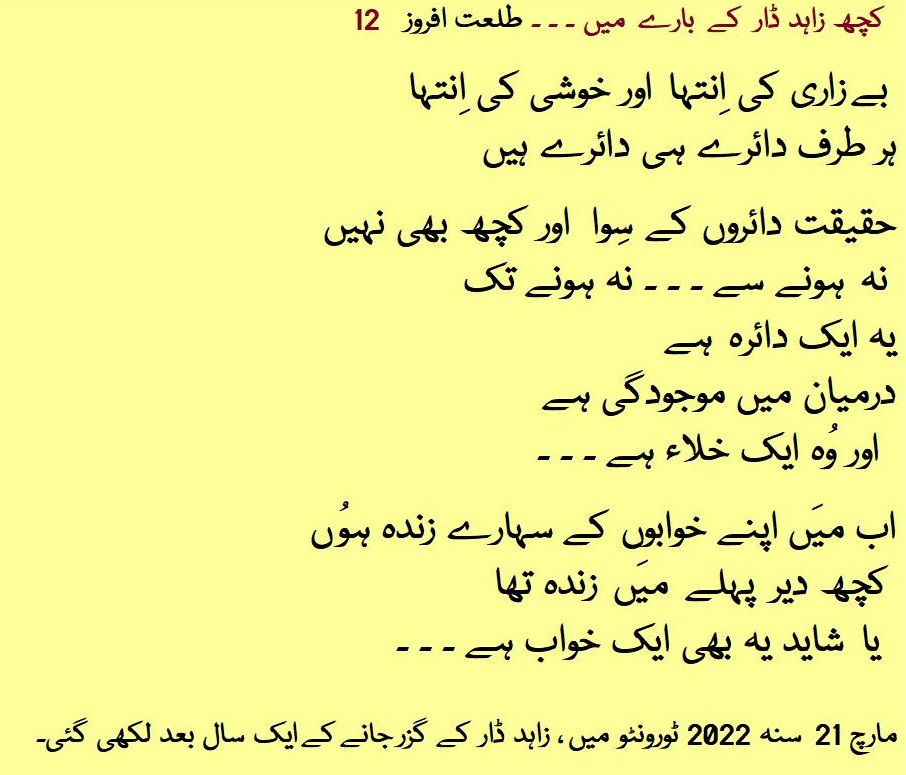
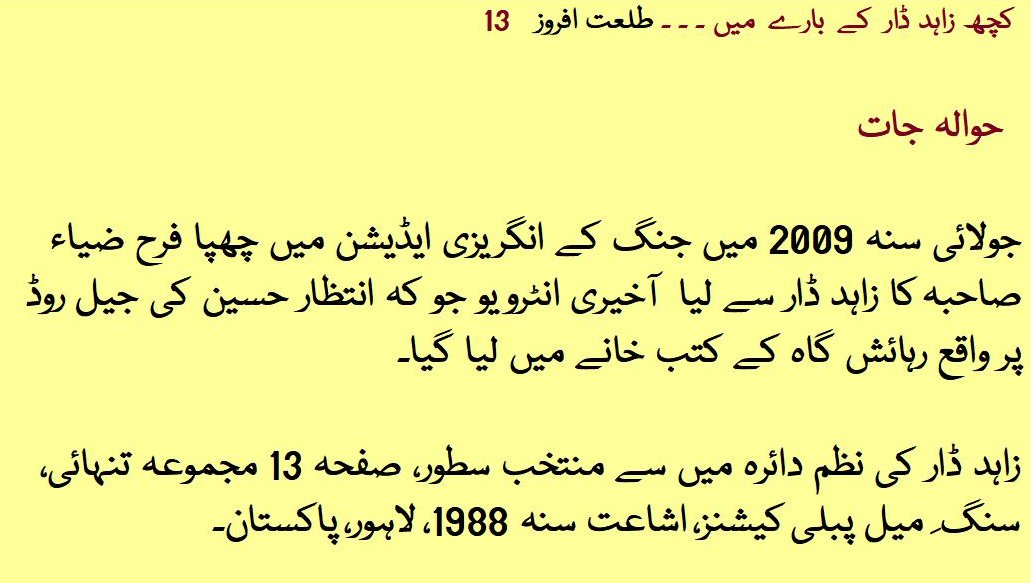
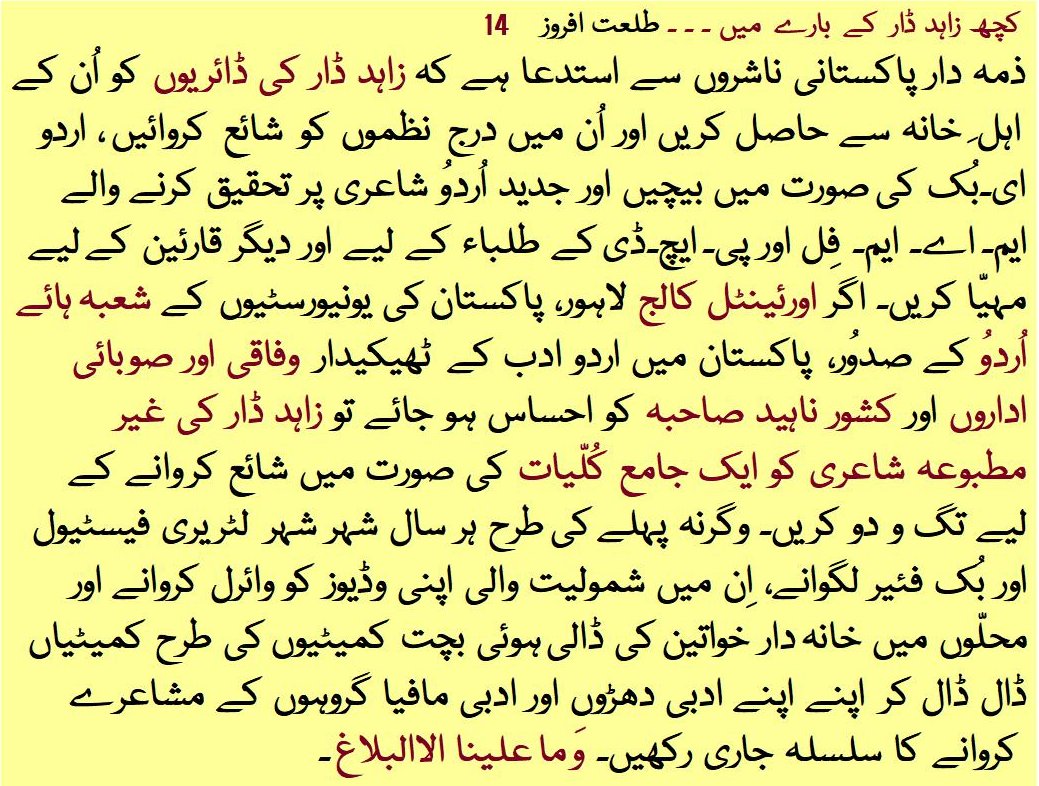
Zahid Dar (1936 - 2021) was a Modern Urdu Poet who passed away on 14th February, 2021.
You may read his Urdu poems and his Interview with a journalist at these web links to my Modern Urdu Poetry web site Dareechah :
http://www.dareechah.com/modern_urdu_poems/zahid_dar_poems
http://www.dareechah.com/modern_urdu_poems/zahid_dar__biography
"I don't know why but I have always liked women."
Quote from the last interview of Zahid Dar given to Ms. Farah Zia published in July, 2009 for the daily The News, (Jang Group of Newspapers), Lahore, Pakistan.
URL link: http://jang.com.pk/thenews/jul2009-weekly/nos-26-07-2009/lit.htm#1
All he wants in life is to read
by Farah Zia
Pak Tea House, an iconic literary cafe of Lahore, Pakistan, was breathing its last in the early 1990s. For many it was already dead, though no formal death certificate was issued as yet. Fresh in the world of journalism, straight out of the legendary Government College (Lahore, Pakistan, an educational institution which has trained and nurtured innumereable Pakistani intellectuals, poets, fiction writers for a hundred years or even more i.e. the entire 20th century) that had maintained close relations with Pak Tea House for decades, I would occasionally stop by to see what was left of this mesmerising place and have some tea, too.
It looked plain and cold, each time I went during day time.
Tea House did not cease to interest me; Sundays were special when there was the weekly Halqa meeting in the evening and the oldies, now settled in different corners of the city, managed to converge here.
A feature on Pak Tea House, just like the usual favourites including one on eunuchs and Lahore's red light area, captured the thoughts of a young journalist. A chance to meet all names I had been generously fed on in the two years in Government College. Muzaffar Ali Syed, Masood Ashar, Intizar Husain and many more; a chance to ask them if they remembered Nasir Kazmi, Shakir Ali, the list was endless. It turned out that everyone I met uttered the so far unfamiliar name -- Zahid Dar. It seemed impossible to cross the river called Pak Tea House without making this necessary encounter.
Who is Zahid Dar? "He reads books and the Tea House is like home to him." So what? "He is a published poet." That was long time back and no one said he was a significant poet. That made the two of us. Two people interested in Pak Tea House without actually having done much for arts or literature. The sheer volume of his reading made him stand apart though; he had read more than all of them put together.
The newspaper feature happened without actually meeting Zahid Dar.
The name remained stuck in memory and it wasn't long before I decided he would make a good subject for a profile interview. I did find him in the Tea House with a book in his hand. A curious-looking, unassuming figure, Dar was initially reluctant to give the interview. I was not interested in wanting to figure out why he decided to finally grant this interview, his first ever. We sat in the Lords on the Mall and he talked. I recorded it on tape and published it. Some of those original thoughts stayed in mind while one heard his name in one context or the other in the years that followed.
Only the other day, a phone call rekindled the interest. A gentleman called to inquire if I had a copy of my interview with Zahid Dar. A student of M-Phil at Government College, he said he was doing thesis on him and wanted to see the only interview he had given in his life. I did not have that interview. Nor did Zahid Dar, he told me. But, he said, he did find a few things written on him including the most interesting sketch by Intizar Husain called 'Faaltoo Aadmee'.
Zahid Dar must have been the worst affected orphan of Pak Tea House's closure, I thought. More than fifteen years had gone by. Is he still reading books? Where is he? His best friend Gulnar was not in the country. Maybe Intizar Husain could help. "You will have to come to my place to meet him. Come in the evening. He is here by then," Intizar Sahib tells me on the phone; his house must be the new adda for the erstwhile orphans, I gathered.
A composed Zahid Dar sat in the verandah in Intizar Husain's old beautiful Jail Road house. The afternoon rain had just washed out the humidity from Lahore's system, at least for a day. We quickly ran through fifteen years of our lives after which I made a request for another interview. Once again, it was granted with reluctance.
The next day, at Intizar Husain's place, I told Dar I wanted his biographical details. This time I wanted to know what was clearly avoided in the first interview. I wanted to know the man. There could not have been a better setting for the interview; Husain's study room, loaded with books, Dar's major preoccupation in life. The next one hour was spent in listening to one of the most interesting stories of my life.
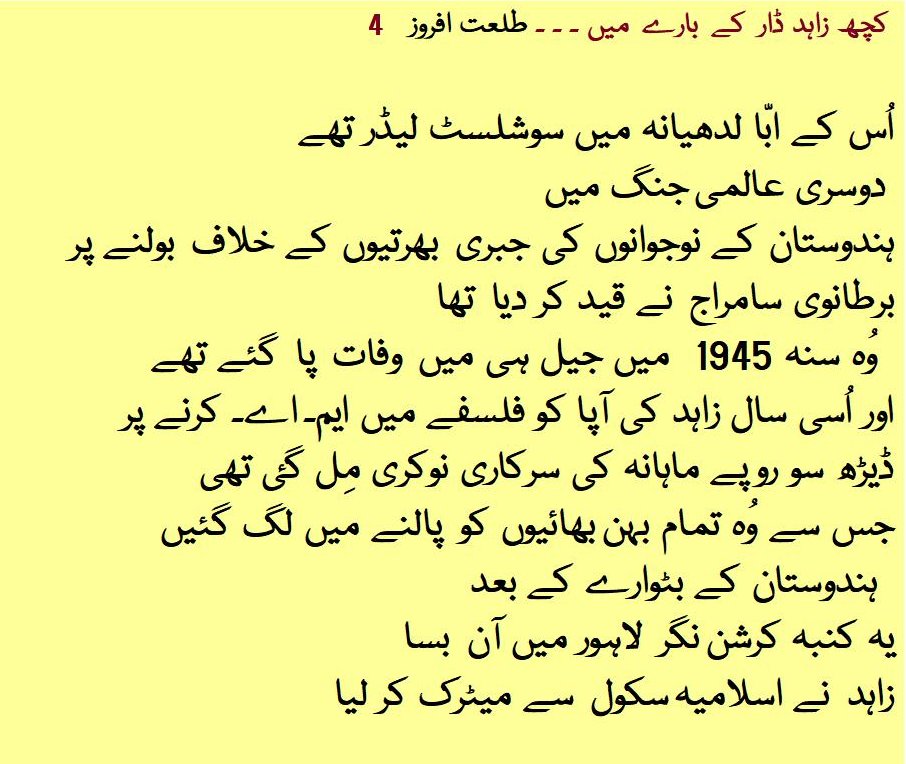
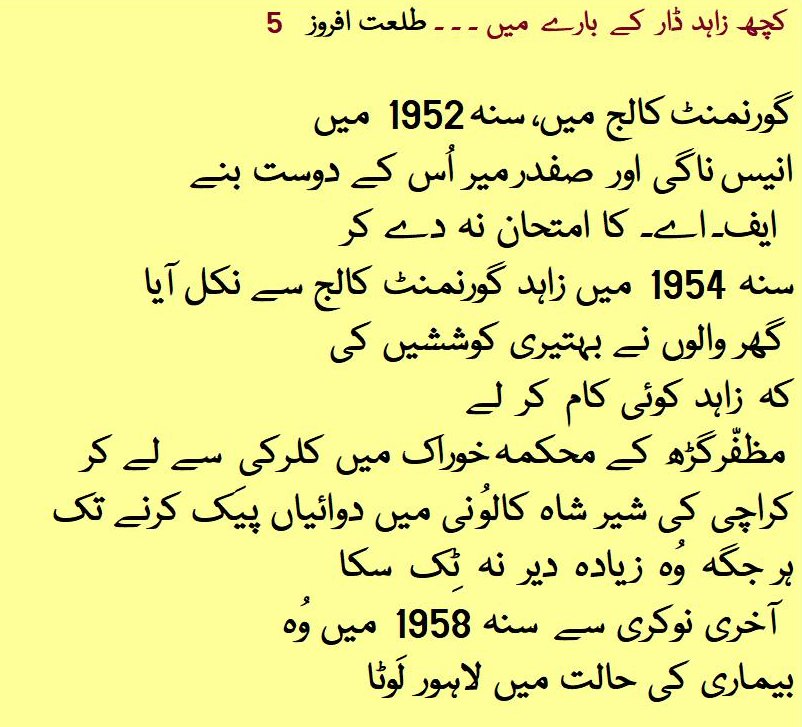
Born in Ludhiana in 1936, Dar was in grade six when the country was divided. His family came to Lahore where he did his matriculation from Islamia School in 1952 and got admission in Government College the same year. He continued going to the college for two years, "to discuss literature with friends like Anis Nagi and others but did not take the intermediate examination." He opted for Economics but when he opened the first page of the book, he found it too boring and closed it. It was because of Economics that he did not take the exam. Incidentally, his elder brother Hamid Dar has been a professor of Economics, and believed to be one of the best, at the very college all these years.
A consistent man, Zahid Dar knew at the age of sixteen that he had no inclination of doing any work. All he wanted to do in life was read literature. He kept going to Government College with his friends for two years. Then his friends left the college, and so did he.
I noticed that Zahid Dar looked at peace with himself. The first time, his eyes rolled quicker, his demeanour was slightly agitated. Now his eyes looked like a know-all philosopher's. He still held a cigarette in hand and laughed like a child, often at himself. He had a lot more to say about life but his views followed the same direction as before, particularly his views on religion. I was eager to know a lot more.
"So I wandered here and there. Sometimes the family or acquaintances would ask me to find some work. I went to Muzzafargarh to work as a junior clerk in the Food Department. I worked for four months but did not get any time to read books. I thought my life was going waste, going to office in the morning, returning in the evening. So I quit the job and came back. Then again in 1958, when Ayub Khan imposed his martial law, I went to Karachi. There was a medicine factory in a place called Sher Shah, and I used to work there along with many women, packing medicines in boxes. In less than a month's time, while going to the factory, I fell down unconscious. People gathered around me, some of them sympathised. I returned home again and stayed sick for quite some time. My brothers and sisters told me to forget about doing a job. I could just sit and read and they promised to feed me. This was December 1958. Till today, I am still reading."
He now lives with a brother and a sister in their house in Krishan Nagar. Another sister lives independently. Most of the siblings decided to stay unmarried. His father was a member of the socialist party and was therefore put in jail in Lahore like many other leaders of the party which did not support the British in the second world war. He died in jail in 1945, the same year when his eldest sister completed her masters in philosophy and became a lecturer in Ludhiana for Rs150. She was left to raise her seven siblings. Theirs was "a feminist household" and this respect for women they owed to their father.
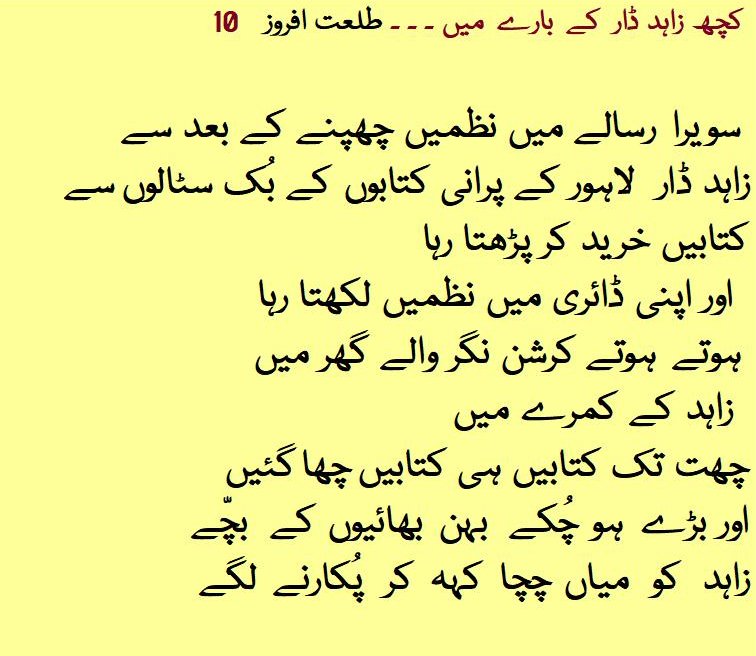
Around 1957-58, he started going to the Tea House and Coffee House with Safdar Mir who he knew from school days since he was a good friend of his elder brother. "He was my favourite poet and I'd told my brother that I had collected all his poems that were published here and there. Safdar Mir was very glad to know this. He used to live in a room in Hotel de Palace in Anarkali's Bakhshi Market which was full of books. I would borrow books from him to read and go and meet him in the evening for a discussion. Together we would go to the coffee house and met his friends. I had read Intizar Husain's novel Chand Gihan, and his stories Kankari and Gali Koochay, his three published works by then. I had really liked Intizar Husain and told Safdar Mir that I don't believe in the criticism against him that he has brought a" Muhawaron ki bori" (sackful of idioms) from UP and unleashed them here. I thought he wrote very modern prose. One day when we were passing by the Coffee House, he shouted, "Intizar Husain yeh larka tumhari kitaben khareed kar parhta hey" (this boy buys your books and reads them). That's how I was introduced to him and we have stayed together ever since."
They started going to the tea house together. Safdar Mir asked him if he only read or did he also write? Dar told him that he wrote his diary in poetic form. He saw them and said they were "poems". Dar didn't want to get them published but Mir gave them to Muhammad Hasan Askari who had started editing a new magazine by the name of Saat Rang from Karachi and they got published under the name of pen-name of Madho. Nasir Kazmi let the secret out in the tea house and everyone knew who Madho was. Then Intizar Husain wrote an article in the next issue of Saat Rang titled "Poochtey hain wo ke Madho kaun hey"
"That's how I became popular in the literary world. Askari Sahib said that the poems created a sensation and he received letters from India asking who this new poet was. People started calling me by the name Madho which I didn't like, so I said that now I'll publish these poems under my own name and I did. Then my poems were published in Savera."
Those were the heydays of tea house; there used to be a lot of literary gatherings in those days, especially the young students from colleges would come after having read T.S. Eliot, Ezra Pound, D.H. Lawrence and others. "But then they either stopped reading or didn't come round to the tea house for discussion."
Did he write again? "I only wrote poems about the limited experience I had. Since I already wrote my diary in the form of poems and had been reading poetry since my childhood, I kept writing poems. After a while I found it difficult to rhyme and when there came a wave of prose poems, I started writing prose poems. Those too got published and then I didn't write again. I didn't have the thoughts or feelings. You can only write about your feelings till the age of thirty or so; after that you need thoughts. There are very few who live and write up to the age of seventy on the strength of their feelings like Faiz. Faiz was a lyrical poet."
Meanwhile Zahid Dar kept reading and thinking and reading. Apart from literature, he read philosophy and liked Russell's ideas the most. "I could not have made decisions or drawn conclusions about life. Russell's answers satisfied me the most."
Did he not detest his life sometimes or want a change like being in love or think of getting married? "I did. I was very romantic in my youth; also because I was reading and writing poetry. I was in love with the idea of love but whenever there was a chance, the girl would invariably ask me to go find some work. Only then she would agree to marry me. I wasn't bothered about bread and butter issues all my life. I thought love was its own reward. I used to say and think a lot of nonsense. Once, a girl became my friend. She asked me to quit smoking. I said I'll only do if a girl held my hand. She did and in five minutes she let go of my hand. I immediately lit another cigarette. She asked me why I did that. I replied "because you left my hand." She said you'll drive me mad and went away."
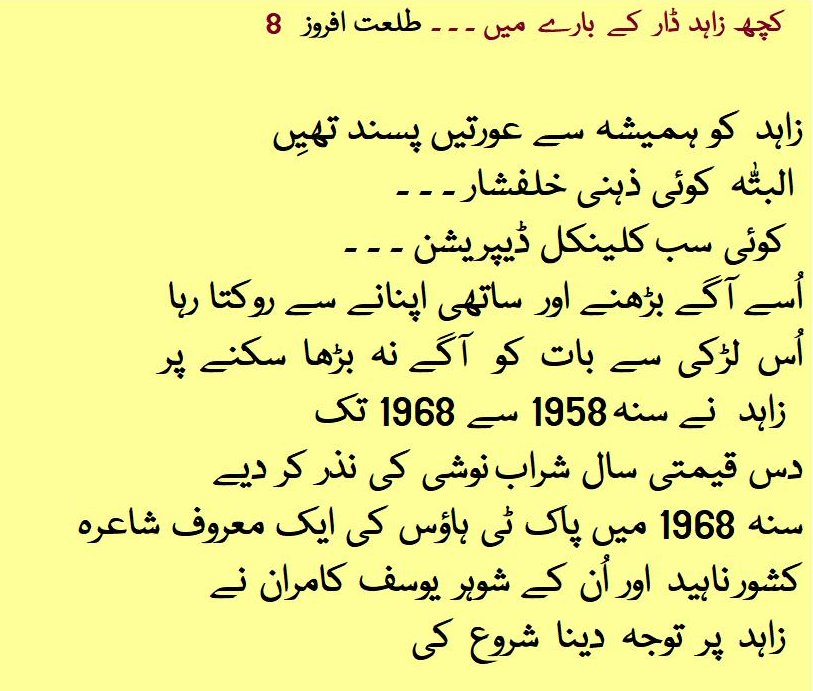
Dar did regret this because there was this very strong urge in him to love. There was much frustration at the unrequited love and as a consequence he wasted about ten years of his life drinking day and night, wishing for an early death. "Then I met a poet when I was about 32 who developed sympathy for me and together with her husband decided to save me. Whenever they saw me drunk, loitering about the Tea House, they would take me home, feed me and then drop me back home. Her sympathy compensated for the loss of love and on her insistence I quit drinking and returned to reading books." I wonder what stops him from acknowledging Kishwar Naheed at this point.
He kept making this resolve to write but when he looked around, he didn't quite like what he saw. All the countries of the world engaged in brutality of one kind or the other. "I could not have imagined that in a twentieth century communist country, Yugoslavia, where humanism had been taught for forty fifty years such violence could take place. So what is a human being and who should one write for?" His view that people could become better human beings after reading literature was shaken. "I think at some point the barbarian within man comes out."
Dar who called himself a communist in his youth and wanted to wage a war on America, imperialism and capitalism does not believe so any more. He did not like what happened in Russia under Stalin or in China under Mao. "In China they sent their biggest poet in a village to clean toilets. Whoever gets power becomes a tyrant." But why support capitalism? "Because, it grants certain freedoms. Under Stalin or Mao there were none. China's best writers are living abroad. Such a big country, with 1.5 billion people, should create great literature but people have to live abroad and write."
But they aim to raise the standard of life of their people, don't they, I ask. "But that is not what all the people aspire for. Human beings need certain freedoms, even if the majority needs a good standard of life, what about those who need to create literature or create art. What about them? It's just like an Islamic society where there is no place for you if you don't follow or practice Islam. This is what a capitalist society allows. You can live the way you want to live. The situation is ideal in some European countries, like Sweden, Norway, Denmark."
Zahid Dar's conclusions about life are varied; there are some you can't agree more with and there are some you would strongly oppose. As for him, he couldn't care less what you thought. "I can't stand masses, they are intolerable. They don't have a mind, only crude unbridled power and wherever they apply it, it causes destruction. Maybe educating the masses brings some difference but, here, look at how even the lawyers become barbarians."
"The three words of Jinnah -- unity, faith and discipline -- are a recipe for disaster. They kill an individual. Every man should think about solutions for himself. All ideologies, religious or otherwise, are against people. I don't even believe in nation states; all people should live together; there should only be some administrative division of the world in some way; Europe has shown to the world that it is possible."
"What two-nation theory? To begin with, we made a mistake by separating from India where people had lived together for centuries. What are we doing with this one nation. There is a freedom movement going on in Balochistan; they are killing Punjabis; in DI Khan they have announced to kill all Shias and have warned them to accept Islam. There are killings going on in Karachi. Taliban-type people trained by our intelligence agencies since the times of Zia have been let loose upon us." Zahid Dar is consistently against religion as an ideology. He would rather have a dictator than a democrat professing a religious system of governance. Nehru is his ideal leader because he was a "true secular." "For the last 1500 years, religion has closed the minds of billions of people. I want this to end. They must think."
He does not miss any friends. "People come and go, I have seen so many of them go. Intizar Husain wants me to die before him because he says if I didn't, who is going to write a column on me. In all these years, I have stayed close to Intizar Husain. I had good friendship with Kishwar Naheed. She held literary meetings at her place and that's how I became acquainted with many people from here and abroad. Then she left for Islamabad."
Zahid Dar kept writing a diary, this time in prose. "Publishers have asked me to give some of it for publication. But those are my personal thoughts; mostly against people and in favour of women.
" Why in favour of women? I ask him...
"I don't know why but I have always liked women !!"
Email: ramisj@gmail.com
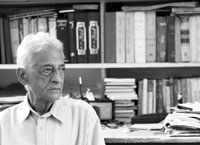
Zahid Dar ... a modern Urdu Poet from Lahore, Pakistan.
Dareechah-e-Nigaarish
Toronto, ON
Canada
talat